We measured ourselves. Then published the math.
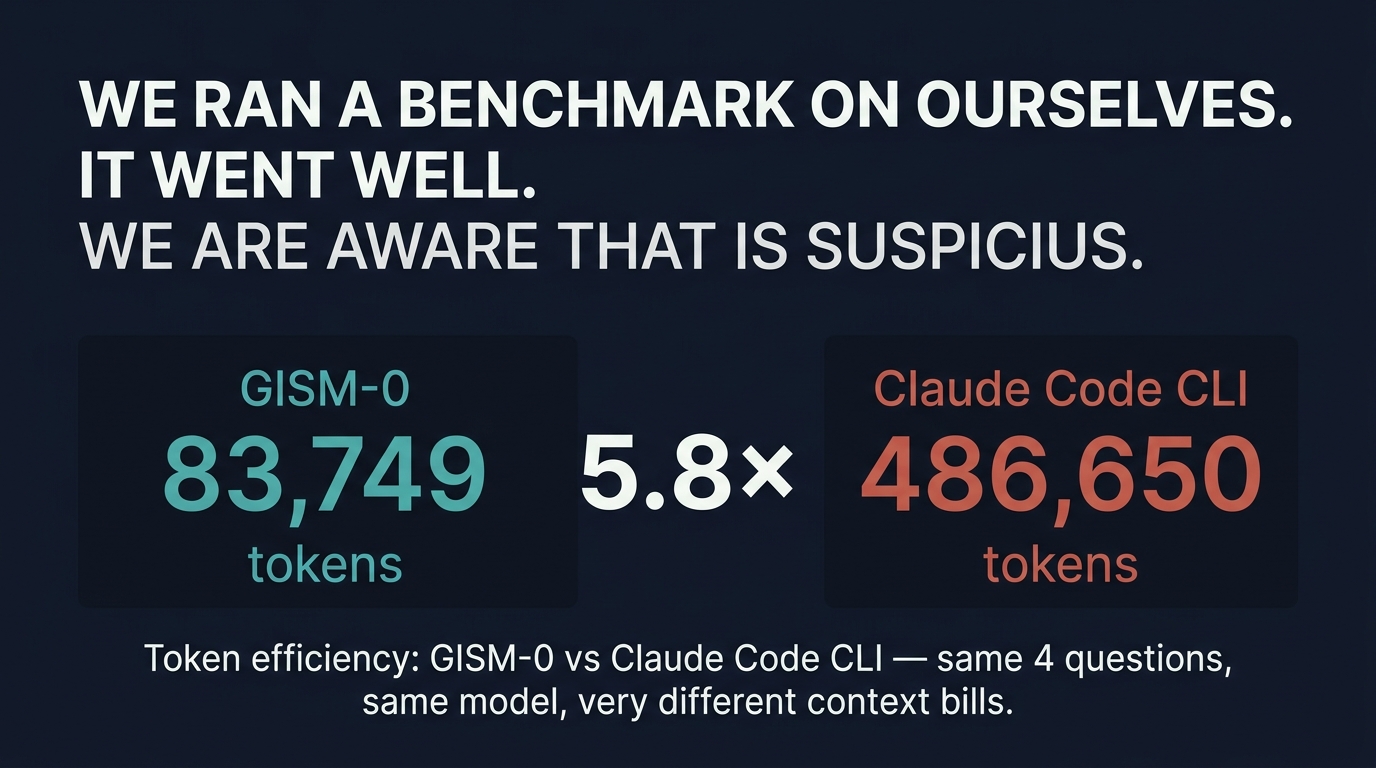
GISM-0, our graph-native memory system, used 5.8× fewer tokens than Claude Code CLI on the same four questions. We are disclosing the methodology, the caveats, and the reason Question 1 went the wrong way — because publishing just the good number would be tacky.
 It knew where to look.
There is a well-established tradition in computer science of publishing benchmark results and quietly omitting the uncomfortable ones. We considered this tradition carefully before rejecting it. What follows is the honest version.
The test: four factual questions, answered by two systems — GISM-0 and Claude Code CLI — against the same live workspace, using the same underlying model (Claude Sonnet 4.6). The metric: total tokens consumed. Fewer tokens means cheaper inference, faster responses, and the kind of unit economics that shows up on a quarterly budget comparison in a way that is very hard to argue with. Or argue away.
The numbers, for those who came for numbers
| 5.8×Token EfficiencyGISM-0 vs. Claude Code CLI | ~83%Lower CostAggregate inference | 18%Lower LatencyResponse time |
Both systems answered all four questions correctly. The difference was not accuracy — it was how much of the context window each system consumed getting there. Claude Code CLI read files. GISM-0 traversed a knowledge graph and retrieved only the facts the question required. The question determined the prompt size. The architecture determined the question-to-prompt relationship. One of these is more interesting than the other.
Four questions. One run. An internal workspace. Evaluated by the people who built the system. Aggregate token counts only — per-question instrumentation was not captured. Question 1 actually performed slightly slower but still used fewer tokens under GISM-0. We are publishing this anyway, because directional evidence that is honestly labeled as directional evidence is more useful than waiting for a perfect study that does not yet exist and will probably also be imperfect.
Yes, Question 1 went the wrong way. GISM-0 took the scenic route through the graph when a direct search would have been faster. We documented this. We debated whether to call it a limitation or a finding. We settled on: both, with footnotes. The aggregate still shows 18% faster overall. We are not sure whether that makes the Q1 result a footnote or an asterisk, but we are fairly confident it makes it a data point.
“Both systems received the same questions, the same workspace, and the same underlying model. The intelligence is identical. The retrieval is not.”
Why the gap exists (the non-handwavy version)
Token cost is a function of context size. Loading a file into context to find a fact costs the full size of the file. A graph traversal retrieves only the nodes and edges the question requires — the question determines the prompt, not the file. At small scale, this is a curiosity. At enterprise scale, it compounds into a structural line-item difference. We have not benchmarked at scale. We are saying this out loud so you know we know.
The documents, for those who want to verify the arithmetic
Two supporting documents accompany this article:
- GISM-0 Benchmark Whitepaper — Full methodology, raw token counts, architecture overview, and an analysis of what actually drives the efficiency gap. The primary technical record. Approximately forty minutes of reading, depending on how much you annotate.
- GISM-0 Benchmark Deck — Slide-format summary for presentations. For the meeting where not everyone has forty minutes, or the stamina.
GISM-0 is not a research prototype. It is the retrieval layer running in production under CleverThis's platform tools today — the same system that contributed materially to a 95.5% reduction in our own AI infrastructure bill in a single quarter. The benchmark is evidence the architecture is performing as designed. We think that is worth reporting, with the caveats attached — which, we trust, we have now supplied at considerable length.